
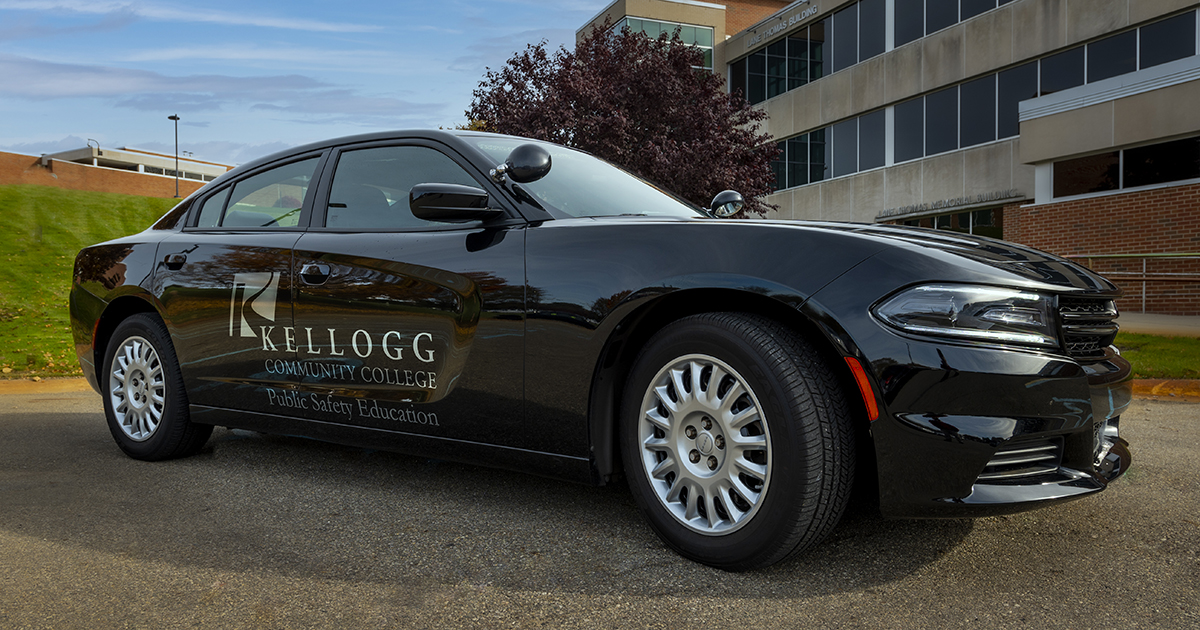
LAW ENFORCEMENT POLICE ACADEMY
Start Your Law Enforcement Career at KCC
Thinking about becoming a police officer? KCC’s Police Academy is one of the most respected training programs in Michigan, known for its high standards and strong reputation statewide. Our graduates have achieved a 100% pass rate on the MCOLES licensing exam for over 10 years, and 95% secure employment in law enforcement within a year of graduation.
Please note: We are currently only running the Regional Police Academy. Because of this, it’s highly recommended that you apply with a local law enforcement agency—such as a police department, sheriff’s office, or department of public safety—before applying to the academy or college. These agencies often sponsor recruits by covering tuition and providing a full-time salary during the academy.
Here’s what you need to know about the Regional Academy:
-
- It runs Monday through Friday for 19 weeks.
- Sponsored recruits are paid and have their academy tuition covered by the hiring agency. See the list of Recruiting Law Enforcement Agencies in the menu below.
- Upon completion, you can apply for a Certificate in Law Enforcement, which can then be applied toward an Associate of Applied Science in Law Enforcement at KCC.
- Students can send themselves through the academy, but all prerequisites must be completed prior to the start of the academy. Please note that employed recruits receive priority seating, so seats for non-employed students may not be available.
- If you’re interested in earning your associate degree in law enforcement while completing the academy, please contact our office to learn how to get started.
Questions?
Contact Public Safety Education at 269-660-7703.
Police Academy – Additional Information
Your content goes here. Edit or remove this text inline or in the module Content settings. You can also style every aspect of this content in the module Design settings and even apply custom CSS to this text in the module Advanced settings.
Employment Standards for Michigan Law Enforcement Officers
The chart below outlines the licensing standards published by the Michigan Commission on Law Enforcement Standards (MCOLES). Employment of law enforcement officers is subject to compliance with these standards. Agencies may set standards more stringent than these; however, the burden is upon the agency to demonstrate that a more stringent standard is related to the ability to perform the essential job functions and is otherwise in compliance with applicable law.
All preservice and agency employed recruits must be screened to all the academy enrollment standards, and all reciprocity candidates considered for employment must be screened by the agency for compliance with all standards.
The licensing standards published under the authority of 2016 PA 289 are found in Rules 28.14203 through 28.14207 of the Michigan Administrative Code.
|
Category |
Standard |
Comments |
|
Age |
Not less than 18 years. |
No maximum age. |
|
Citizenship |
United States Citizenship. |
Birth Certificate; Certificate of Naturalization; Valid United States Passport. |
|
Education |
High school diploma or GED is the minimum for an employed recruit. Pre-service recruits must have a minimum of an associate’s degree upon completion of the basic training academy. |
A college degree from an accredited institution is evidence of complying with the minimum standard. |
|
Prohibited Criminal Adjudications of Guilt Enrollment denials begin with the January 2017 academy sessions. |
An applicant with an “adjudication of guilt” for a violation or attempted violation of a penal law of this state or another jurisdiction that is punishable by imprisonment for more than 1 year (includes all felonies) will be denied a license. An applicant with an “adjudication of guilt” for a violation or attempted violation of certain misdemeanors (listed in the accompanying comments) will also be denied a license. An “adjudication of guilt” includes a judgment or verdict of guilty, or guilty but mentally ill, following a trial or a plea of guilty or nolo contendere (no contest), even if the conviction was subsequently expunged, set aside or dismissed by virtue of a delayed sentence or diversion program. This includes delayed sentences under MCL 771.1; adjudications in conjunction with assignment to the status of youthful trainee under the Holmes Youthful Trainee Act; dismissals after probation for first-time drug offenses under MCL 333.7411; and dismissals under MCL 769.4a of first-time aggravated domestic violence offenses (MCL 750.81a(2)). |
Disqualifying offenses include adjudications of guilt for a violation or attempted violation of a penal law of this state or another jurisdiction that is punishable by imprisonment for more than 1 year (includes all felonies). Disqualifying offenses also include adjudications of guilt for violations or attempted violations of any of the following misdemeanors under Michigan law or substantially corresponding laws of another jurisdiction: Operating While Intoxicated, 2nd Offense (MCL 257.625(1),(8), (9)(b), (25)); Possession of Controlled Substances (MCL 333.7403(2)(c)) (does not include marijuana); Use of Controlled Substances (MCL 333.7404(2)(a), (b), or(c)); Domestic Violence, 2nd Offense (MCL 750.81(4)); Aggravated Assault (MCL 750.81a(1)), Aggravated Domestic Violence (MCL 750.81a(2)); and, Stalking (MCL 750.411h). |
|
Character Fitness |
Character fitness, as determined by a background investigation supported by a written authorization and release executed by the individual. |
Includes arrest and expunged convictions, all previous law violations, personal protection orders, traffic and civil infractions and ordinance and code violations. |
|
Driver’s License |
Possess a valid operators or chauffeur’s license. (all 50 states, DC, territories of the US, and Canada). |
May not be in a state of suspension or revocation. |
|
Physical Ability |
Be free from any physical defects or chronic diseases which may impair the performance of a law enforcement officer or which may endanger the lives of others or the law enforcement officer. |
This includes, but is not limited to, diseases such as diabetes, seizures and narcolepsy. Each case shall be investigated to determine its extent and effect on job performance. The evaluation should include the expert opinion of a licensed physician specializing in occupational medicine. |
|
Hearing |
Initial unaided testing involving pure tone air conduction thresholds for each ear, as shown on the pure tone audiogram, shall not exceed a hearing level of 25 decibels at any of the following frequencies: 500, 1000, 2000, 3000 Hertz; and 45 decibels at 4000 Hertz. |
Initial testing may be performed by a certified hearing conservationist, a licensed hearing aid specialist or a licensed audiologist. See Note for individuals requiring additional unaided or aided testing requirements by a licensed audiologist.* |
|
Psychological |
Be free from mental or emotional instabilities which may impair the performance of essential job functions of a law enforcement officer or which may endanger the lives of others or the law enforcement officer. |
Mental and emotional stability may be assessed by a licensed physician, or a licensed psychologist or psychiatrist. MCOLES may require the examination be conducted by a licensed psychologist or psychiatrist.** |
|
Vision, Color |
Possess normal color vision without the assistance of color enhancing lenses. |
The unaided eye shall be tested using pseudoisochromatic plates. The Farnsworth Dichotomous D-15 panels shall be used for any candidate who fails the pseudoisochromatic plates. |
|
Vision, Corrected |
Possess 20/20 corrected vision in each eye. |
Acuity may be corrected with glasses or contacts. |
|
Vision, Normal Functions |
Possess normal visual functions in each eye. |
Includes peripheral vision, depth perception, stereopsis, etc. |
|
Reading and Writing |
Pass the MCOLES reading and writing examination or an |
Does not apply to Recognition Prior Training & Experience Program applicants. |
|
Physical Fitness |
Pass the MCOLES physical fitness pre-enrollment examination. This does not apply to Recognition of Prior Training & Experience Program applicants. |
Pre-enrollment testing is required for admittance to an approved basic training program. |
|
Training |
Successfully complete the MCOLES mandatory basic training curriculum. |
This may be done by successfully completing an approved college preservice program or a basic training academy. Candidates seeking reciprocity from other states may apply for the Recognition of Prior Training and Experience Program. |
|
Licensing Examination |
Pass the MCOLES licensing examination upon the completion of mandatory basic training. |
For Recognition of Prior Training and Experience Program (RPTE) candidates, successfully complete the RPTE Program and pass the licensing examination. |
|
Fingerprinting |
Employing agencies must fingerprint the applicant with a search of state and Federal fingerprint files to disclose criminal record, personal protection orders, mental health orders, firearms possession prohibitors, expungements and dismissals based on a diversion program. Academies require fingerprinting using the CHRISS system. |
|
|
Oral Interview |
Conduct an oral interview to determine the applicant’s suitability for a law enforcement officer position. |
|
|
Drug Testing |
Cause the applicant to be tested for the illicit use of controlled substances. |
Must use a Commission certified laboratory and comply with Commission procedures. |
* Agencies with an applicant who fails the initial hearing standard should contact the MCOLES Standards Compliance Section for additional unaided and aided hearing criteria as well as testing protocols.
** Agencies are encouraged to request the assistance of the Standards Compliance Section of MCOLES when their employment process reveals that a candidate may not comply with a state standard. This is particularly true with medical conditions which may involve circumstances unfamiliar to the agency and which require medical opinions. Please call 517-636-7864 with any questions.
Recruiting Law Enforcement Agencies
Albion Department of Public Safety
Lt. Bill Timmins
517-629-7826
[email protected]
Job Applications: Employment Opportunities
Bangor Police Department
Chief Justin Weber
269-427-5831
[email protected]
Job Applications: Job Postings | City of Bangor, Michigan
Barry Township Police Department
Cheif Jenny Johnson
269-623-5512
[email protected]
Detective Karen Larson
269-623-5512
[email protected]
Battle Creek Police Department
Cpl. Emily Leach
269-966-3306 ext 1068
[email protected]
Job Applications: Police Career Opportunities | Battle Creek, MI
Branch County Sheriff’s Office
Undersheriff Jason Bingaman
[email protected]
Job Applications: https://branchcounty.gov/sheriff/
Calhoun County Sheriff’s Office
Lt. David Homminga
Office of Professional Standards
269-967-4461
[email protected]
Job Applications: https://www.calhouncountymi.gov/departments/sheriffs_office/work_with_us.php
Cass County Sheriff’s Office
Tracy Monroe
269-445-1201
[email protected]
Job Applications: https://www.casscountymi.org/Jobs.aspx?UniqueId=100&From=All&CommunityJobs=False&JobID=Deputy-SheriffRoad-Patrol-7
Coldwater Police Department
Director Joseph Scheid
517-278-4525
[email protected]
Deputy Director Patrick Beeman
517-278-4525
[email protected]
Decatur Police Department
Chief Tom VanDerWoude
269-423-2171
[email protected]
Kalamazoo County Sheriff’s Office
Lt. Bryan McLain
269-383-8749
[email protected]
Job Applications: Employment Opportunities | Kalamazoo County, MI
Marshall Police Department
Sgt. Robert Ritsema
269-781-2596
[email protected]
Nashville Police Department
Chief Chris Underhile
517-852-9866
[email protected]
Paw Paw Police Department
269-657-5501
www.pawpaw.net
Portage Department of Public Safety
Lt. Michael Collier
269-329-4530
[email protected]
Job Applications: Career Center | Recruitment
Sgt. Nicholas Mattson
269-324-9207
[email protected]
Job Applications: Career Center | Recruitment
Prairieville Township Police Department
Chief Michael Reizin
269-623-2691
[email protected]
Richland Police Department
Chief Jeff Mattioli
269-629-4807
[email protected]
Springport Township Police Department
Chief Brent Lincoln
517-857-2030
[email protected]
Three Rivers Police Department
D/Sgt. Steve Dibble
269-278-1235, ext. 216
[email protected]
Police Academy Application Forms
2024-25 Police Academy Application Forms
We are currently only running Regional Police Academies for the Fall 2024 and Spring 2025 semesters.
Students interested in attending the academy through a law enforcement agency should apply directly with that agency.
Students interested in sending themselves through the academy should contact the Criminal Justice office at 269-660-7703.
Students should not complete KCC’s Police Academy application until they are sure they meet the requirements to start the Police Academy portion of the Law Enforcement degree. The general education courses do not require this application. Students unsure about whether or not they are ready to apply should contact KCC’s Criminal Justice Office at 269-660-7703.
Please review all instructions before completing the application.
All forms below should be downloaded and returned as part of your application packet. NOTE: These documents are best viewable on Adobe Reader (get.adobe.com/reader). It is best to download the forms to your desktop and then open them. If you complete forms in your web browser, the data may not save.
Law Enforcement Certificate
Students must be accepted into the Police Academy in order to enroll for the Law Enforcement Certificate Program. Contact the department for more information.
Law Enforcement Careers
KCC’s Police Academy prepares students to become certifiable as police officers in Michigan. Upon obtaining employment within a department, graduates can advance their careers to positions as sergeants, lieutenants, detectives, K9 officers and others based on the availability of positions within their department. Current job postings can be found online at michigan.gov/mcoles.
Possible job areas/titles for graduates with an education in law enforcement include:
- Deputy sheriff
- Police officer
- Tribal police
Projected Job Outlook & Salary Info
For the latest employment and wage estimates for law enforcement careers in Michigan, visit the U.S. Department of Labor’s Bureau of Labor Statistics website at www.bls.gov/oes/current/oes_mi.htm.
Advising & Transfer
Advising & Transfer
Students who have completed coursework at another institution may be able to transfer those credits to KCC to meet the degree requirements for the Law Enforcement degree.
View transfer guides outlining opportunities for students looking to transfer their KCC credits to a four-year institution. Contact Academic Advising at 269-965-4124 or [email protected] to schedule an appointment to plot a personal transfer plan.
Why Study Law Enforcement at KCC?
Besides offering a schedule that appeals to those who are currently employed or who have additional responsibilities that would prohibit them from attending a full-time police academy, KCC offers a learning environment that promotes adult learning, problem-solving, critical thinking and service-learning. All KCC instructors are subject matter experts and are currently working in the field or are retired from it.
KCC also offers students the use of advanced training technology, including a MILO shooting simulator, two driving simulators and a skid car. This technology allows students to engage in hands-on training similar to that which they may experience in the field.
MILO Shooting Simulator
KCC’s MILO Shooting simulator provides students the ability to use their training to practice use-of-force and shoot/don’t-shoot scenarios within a safe and controlled environment. The MILO system uses two Glock-style handguns equipped with lasers, a taser, pepper spray and long-gun attachments. Common scenarios include patrol operations, active shooter, domestic violence and more.
Driving Simulators
KCC’s two driving simulators mimic a full-view driving course, with one designed similar to a Ford Taurus and the other as a Dodge Charger. These simulators allow students the ability to learn safe maneuvers in a controlled environment.
Skid Car
KCC’s skid car is a Dodge Charger equipped with a skid-car hydraulic attachment. This attachment allows the driver to experience high-speed reactions at lower, safer speeds. The hydraulic system is controlled by the evaluator, who is also in the vehicle during the training. The system mimics skid conditions such as those experienced while driving in snow, ice and other potentially hazardous road conditions.

PUBLIC SAFETY EDUCATION LINKS
SOCIAL SCIENCES, HUMAN SERVICES & CRIMINAL JUSTICE LINKS
Law Enforcement Police Academy Contacts