
RADIOGRAPHY
Applications for KCC’s Radiography Program beginning the Fall 2026 semester are due May 21. See details, application materials and more at kellogg.edu/radi-admissions.
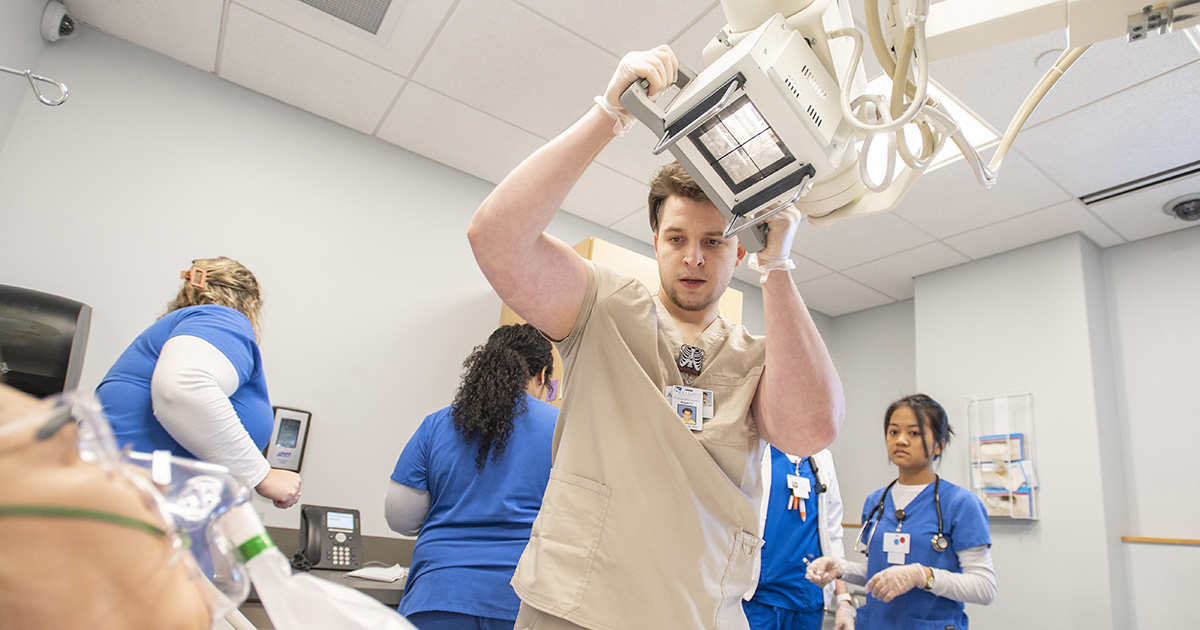
The Radiography Program at Kellogg Community College offers students the opportunity to earn an associate degree in a field that is both rewarding and exciting. Radiographers are essential members of the health care team who use sophisticated X-ray equipment to produce high-quality medical images of the human body. Through KCC’s Radiography Program coursework, students learn patient care skills, pathologies, radiation protection, radiographic positioning and image production.
Radiography Program students will complete five academic semesters. The program’s didactic, laboratory and clinical requirements demand the time commitment of a full-time student. Successful completion of the program leads to an Associate in Applied Science in Radiography degree and eligibility to take the national certification exam administered by the American Registry of Radiologic Technologists (ARRT).
For more information about KCC’s Radiography Program, see:
- Associate of Applied Science in Radiography Program Map
- Radiography (RADI) course descriptions
- Radiography Program FAQs
- Radiography Program Student Manual 2023-2025
- Radiography Admissions
- Kellogg Community College Academic Catalog and Student Handbook
Accreditation
KCC’s Radiography Program is accredited by the Joint Review Committee on Education in Radiologic Technology. KCC program information page on JRCERT website can be found at Kellogg Community College – JRCERT The program was reviewed in 2019 and given the full 8-year accreditation through September 2027. There have been no lapses in accreditation status. Students may contact JRCERT at:
JRCERT
20 N Wacker Dr.
Suite 2850
Chicago, IL 60606
312-704-5300
Fax: 423-304-5304
[email protected]
Additional Information
Program Mission, Goals & Outcomes
Mission Statement:
Building upon the mission, visions, and values of Kellogg Community College, the mission of the KCC Radiography Program is to provide a comprehensive curriculum that will graduate competent entry level radiographers. Graduates of the program will demonstrate critical thinking, professionalism, effective communication, patient safety, and ethical behavior thereby enhancing the healthcare experience of patients.
Goal 1: Graduates will demonstrate the knowledge and skills necessary for competency as an entry level radiographer.
Outcomes:
1.1 Student will apply knowledge of anatomy, physiology, and positioning to accurately demonstrate anatomical structures on image receptors.
1.2 Students will apply the principles of radiation protection to patients, self, and others.
1.3 Students will provide age-appropriate patient care, safety, and comfort.
Goal 2: Graduates will exhibit professional growth and development through the values,
attitudes, and behaviors necessary of an entry-level radiographer.
Outcomes:
2.1 Students will demonstrate positive work ethics with respect to policies and procedures within the clinical setting.
2.2 Students will demonstrate a commitment to their career in medical imaging.
2.3 Students will demonstrate the ability to work as a team player through cooperation and
initiative.
Goal 3: To prepare graduates to demonstrate the ability to apply critical thinking skills and problem solving in their field.
Outcomes:
3.1 Students will apply knowledge of technical factor selection and geometrical properties of the x-ray beam to accurately demonstrate anatomical structures on image receptors.
3.2 Students will demonstrate critical thinking with regard to decision-making and judgment in the clinical environment.
Goal 4: To prepare graduates to communicate effectively and professionally.
Outcomes:
4.1 Students will communicate effectively with patients, patient’s family, staff, administration, and physicians.
4.2 Students will demonstrate effective written communication skills.
Radiography Careers
Radiographers are qualified to operate radiographic (X-ray) equipment; perform radiographic procedures; evaluate radiographic images for technical quality and adequate demonstration of anatomical structures; provide patient care essential to radiographic procedures; evaluate the performance of radiographic equipment; and provide optimum radiation protection for the patient, self and other staff members. Radiographers have the opportunity to seek advanced certification in Computed Tomography, Magnetic Resonance Imaging, Mammography, Vascular Interventional and Cardiac Interventional Technology.
Possible job areas/titles for graduates with an education in radiography include:
- Administrator/manager
- Application specialist
- Educator/clinical instructor
- Radiographer/radiologic technologist
- Sales
Projected Job Outlook & Salary Info
According to the Bureau of Labor Statistics, overall employment of radiologic technologists is expected to grow by 5 through 2034%, increasing faster than average for all occupations.
As of 2024, the Median Pay for radiologic technologists and MRI technologists in the US was $78,980, or $37.97 per hour.
For the latest employment and wage estimates for radiography careers in Michigan, visit the U.S. Department of Labor’s Bureau of Labor Statistics website at bls.gov/oes/current/oes_mi.htm.
Why Study Radiography at KCC?
The Radiography Program at Kellogg Community College offers students the opportunity to experience hands-on learning in the classroom and apply these skills under the supervision of local technologists on patients in the hospital setting.
Nationally Accredited Program
The Joint Review Committee on Education in Radiologic Technology (JRCERT) has awarded Kellogg Community College’s Radiography Program the full eight-year accreditation award through September 2027. JRCERT accreditation ensures our students are provided a high-quality educational experience and that the program meets high standards. To learn more about the JRCERT, visit jrcert.org.
Clinical Experience
While attending KCC, students receive exceptional radiography training through didactic, laboratory and clinical experiences. Over four semesters, students participate in more than 1,000 hours of clinical work. KCC partners with six local hospitals that offer diverse learning experiences for all Radiography students:
- Bronson Methodist Hospital (Kalamazoo)
- Ascension Borgess Hospital (Kalamazoo)
- Bronson Battle Creek Hospital (Battle Creek)
- ProMedica Coldwater Regional Hospital (Coldwater)
- Oaklawn Hospital (Marshall)
- Battle Creek Veteran’s Affairs Medical Center (Battle Creek)
Passionate Instructors
At Kellogg Community College, students have access to passionate and dedicated instructors with more than 30 years of combined experience. Both instructors have worked in hospital settings and are Registered Technologists through the American Registry of Radiologic Technologists. Instructors have degrees ranging from bachelor’s to master’s degrees.
Hands-On Learning
Courses in the Radiography Program at Kellogg Community College are primarily held face-to-face, though there are a few courses offered in hybrid and online formats allowing students some flexibility as they study. In addition to clinical experiences, students practice in the classroom under the guidance of instructors to refine their patient care and positioning skills.
Radiography & Simulation Labs
Funds acquired through the state’s Community College Skilled Trades Equipment Program (CCSTEP) have enabled KCC to offer the latest radiography technology equipment in the industry. Students work with fixed and mobile radiography equipment to learn positioning skills and techniques that they will apply during clinical rotations.
A partnership with KCC’s Nursing Program also gives Radiography students access to new simulation labs on campus. Students will participate in trauma simulations where they encounter real-life scenarios and demonstrate knowledge and skills.
Clinical Education Access Requirements Statement
Students formally accepted to participate in Allied Health, Emergency Medical Services or Nursing programs are required to comply with clinical access requirements prior to and during clinical education placement in a hospital, outpatient clinic or other clinical education setting. These students are required to:
- Undergo a physical examination, immunizations, urine drug screen and criminal background check.
- Secure and maintain CPR certification in Basic Life Support (BLS) from the American Heart Association or Basic Life Support (BLS) for Health Care Providers from the American Red Cross throughout their clinical education participation.
- Adhere to the uniform and personal appearance standards according to program policies determined by clinical education providers.
- Maintain professional liability insurance according to College policies, as required by clinical education providers. The College ensures students are covered with professional liability insurance with the cost collected through lab fees.
Students participating in clinical education are not employees of a clinical education provider or of the College, and therefore are not covered by Workman’s Compensation insurance. It is highly recommended that students maintain personal health insurance while enrolled in an educational program.
Clinical education providers reserve the right to impose additional requirements at any time to ensure the safety of patients, employees and students. Clinical access requirements are determined by the College, according to the policies of the clinical education providers. The program director or coordinator will provide students with detailed direction and timeline for completing all clinical access requirements.
Compliance and cost of clinical access requirements are the responsibility of the student.
Latex Environment Statement
Students participating in Allied Health, Emergency Medical Services or Nursing courses are likely to have contact with latex throughout their educational experience. Due to the broad range of equipment, manikins, materials and supplies used in the College’s practice and simulation laboratories, and within a vast number of hospitals and other clinical education facilities, students with latex allergies considering any of these programs should direct questions to their physician prior to applying to the program to ensure safe participation in a latex environment.
Positive Drug Screen Statement
Applicants who earn admission into a KCC Health Sciences program must complete a drug screening test. This test checks for the presence of 10 substances, which are as follows:
- Marijuana
- Amphetamines
- Barbiturates
- Benzodiazepines
- Cocaine
- Methadone
- Methaqualone
- Opiates
- Phencyclidine
- Propoxyphene
Students with a positive drug screen will be deemed ineligible to participate in clinical education. Furthermore, as clinical education is a critical requirement of Nursing, Allied Health and Emergency Medical Services programs, the student will be dismissed from their current program of study. Students who would like to be considered for readmission should refer to their program’s policy of readmission and direct questions to the program director.
Service-Learning Requirement
Students who obtain an Associate degree or an Associate of Applied Science degree will be required to complete a service-learning experience. The final grade in the course must qualify for academic credit in order to receive the service-learning endorsement. RADI 224, Clinical Practicum, includes a service-learning component during the Summer semester of the program. Upon successful completion of this course and the service learning experience, students will earn the required service-learning endorsement for graduation.
Program Effectiveness Data
The following is the most current Radiography Program effectiveness data. Our programmatic accreditation agency, the Joint Review Committee on Education in Radiologic Technology (JRCERT), defines and publishes this information which can be accessed via https://www.jrcert.org/programs/kellogg-community-college/
Program Completion: The number of students who complete the program within the stated program length. The annual benchmark established by the program is 80%.

Job Placement: The number of graduates employed in the radiologic sciences compared to the number of graduates actively seeking employment in the radiologic sciences within twelve months of graduating. The five-year average benchmark established by the JRCERT is 75%.

Credentialing Examination: The number of students who pass, on the first attempt, the American Registry of Radiologic Technologists (ARRT) certification examination, or an unrestricted state licensing examination, compared with the number of graduates who take the examination within six months of graduation. The five-year average benchmark established by the JRCERT is 75%.

Advising & Transfer
View transfer guides outlining opportunities for students looking to transfer their KCC credits to a four-year institution. Contact Academic Advising at 269-965-4124 or [email protected] to schedule an appointment to plot a personal transfer plan.
Radiography FAQs
What are the job responsibilities of a Radiologic Technologist?
Radiographers must demonstrate an understanding of human anatomy, physiology, pathology, and medical terminology.
Radiographers must maintain a high degree of accuracy in radiographic positioning and exposure technique. They must possess, apply, and maintain knowledge of radiation protection and safety. Radiographers independently perform or assist the licensed practitioner in the completion of radiographic procedures. Radiographers prepare, administer and document activities related to medications and radiation exposure in accordance with federal and state laws, regulations or lawful institutional policy. ASRT Practice Standards, June 23, 2019
Radiologic technologists (also called radiographers) need a blend of technical, clinical, and interpersonal skills to succeed in their role. Here are some key skills:
Technical & Clinical Skills
- Knowledge of anatomy and physiology – to position patients correctly and capture accurate diagnostic images.
- Radiographic positioning techniques – ensuring the correct angles for high-quality imaging.
- Operation of imaging equipment – X-ray, CT, MRI, fluoroscopy, and digital imaging systems.
- Radiation safety & protection – applying ALARA (As Low As Reasonably Achievable) principles for both patient and staff.
- Image evaluation – assessing image quality for proper density, contrast, detail, and accuracy.
- Patient care & safety – monitoring for adverse reactions (e.g., contrast media), recognizing emergencies, and performing basic life support.
Interpersonal & Communication Skills
- Clear communication – explaining procedures in simple terms to patients, including those who may be anxious or in pain.
- Teamwork – working closely with physicians, nurses, and other healthcare staff.
- Empathy & compassion – providing reassurance and support to patients of all ages and conditions.
Professional & Critical Thinking Skills
- Problem-solving – adjusting techniques for trauma patients, children, or those with limited mobility.
- Attention to detail – following protocols, verifying patient identity, and ensuring accuracy of imaging orders.
- Adaptability – handling fast-paced, changing environments, especially in emergency or surgical settings.
- Ethics & professionalism – maintaining patient confidentiality and adhering to medical/legal standards.
- Time management – balancing multiple patients and imaging tasks efficiently.
What is the average salary for a Radiologic Technologist?
According to the U.S. Department of Labor, Bureau of Labor Statistics, the median annual wage for radiologic technologists was $77,660 in May 2024.1
As of January 23, 2025, the average hourly pay for a radiologic technologist in Michigan is $40.19 an hour. This depends on experience, location, and credentialing.
How is the local job market?
Overall employment of radiologic technologists is projected to grow ~5% from 2024 to 2034, which is faster than the average for all occupations. 1
About 15,400 openings per year nationally are expected on average over the decade. Largely the result from replacing technologist who retire or leave the profession, not just new positions.
The local job market for radiologic technologists is excellent. Job placement rate is 100% for KCC Radiography Graduates. There are currently multiple job openings at most of our affiliated hospitals.
1 Bureau of Labor Statistics, U.S. Department of Labor, Occupational Outlook Handbook, Radiologic and MRI Technologists,
at https://www.bls.gov/ooh/healthcare/radiologic-technologists.htm.
What do I need to do to become a Radiologic Technologist?
- Complete an accredited radiography program.
First you must complete a program in radiography that is either programmatically accredited or part of an institution that is regionally accredited. KCC meets the rigorous standards set forth by the Joint Review Committee on Education in Radiologic Technology (JRCERT) and has been awarded the maximum accreditation award of eight years (to be renewed in 2027).
- Pass the ARRT Registry for Radiography.
Upon completion of the didactic and clinical education requirements as outlined by the ARRT, an individual is eligible to sit for a national board examination to obtain certification in the field of Radiography. Upon passing this examination, the credential earned is Registered Technologist of Radiography [R.T.(R)]. Some states may require an additional examination or licensure to practice in the field of Radiography.
Once I become a registered Radiologic Technologist, what are my career options?
Upon completion of a radiography program and licensure by the ARRT, there are numerous career opportunities in a variety of settings. Radiography permits flexibility with a variety of work settings, hours, and commitments. Some possible jobs include:
- Imaging technologist in a hospital, office, clinic, or mobile setting
- Administration/management of a radiology department or other health care setting
- Application specialist
- Educator/clinical preceptor for college or university
- Equipment and imaging software sales
- Research and development
- Post primary certification and registration in other imaging modalities, including MRI, CT, Mammography, Interventional Radiography, Bone Densitometry (DEXA), Vascular Sonography, Breast Sonography, Radiologist Assistant
Where can I learn more about Radiography?
Radiography is an exciting and rewarding career. For more information, you can visit the Association of Registered Radiologic Technologists (ARRT, www.arrt.org) or the American Society of Radiologic Technologists (ASRT, www.asrt.org). You may also reach out to the KCC Radiography Program Coordinator, Mindi Snyder ([email protected], or 269-660-7755) for more information.
How many semesters are in the Radiography program?
Pre-requisite courses must be completed prior to applying to the Radiography program. Upon admission to the Radiography program, students will participate in five semesters of Radiography-specific courses: Fall 1, Spring 1, Summer, Fall 2, and SPRING 2.
What is the homework load like?
Students can expect approximately 3-4 hours of study/homework for every 1 hour of class time (credit hour). Students who spend less than a 3:1 ratio of study time tend to struggle with understanding concepts, which reflects in clinical competency and examination scores. Students who have difficulty with content have access to a variety of resources, including instructor office hours and the center for student success.
Can I work while I am in the program?
Most radiography students maintain jobs while in the program. Work schedules must be conducive to the school schedule. Students who work while successfully participating in the program can prioritize and organize in order to maintain both work and school schedules, as well as achieve the required “c” grade in all courses. Students must be aware that school schedules and assignments will take precedence over work schedules.
Can I choose my clinical rotations?
No. The kcc radiography program affiliates with six clinical sites: bronson methodist hospital, kalamazoo; beacon kalamazoo; bronson-battle creek; oaklawn hospital, marshall; insight hospital & medical center coldwater; corewell health pennock, hastings; and the veterans administration medical center, battle creek.
Clinical assignments are designed to provide a broad educational experience student must be willing to accept an assignment at any of the seven clinical sites. Students will rotate through various sites within the two-year program.
What are the graduation requirements to earn an Associate Degree in Applied Science, Radiography?
Graduation requirements for a degree from kellogg community college can be found by accessing the academic catalog. Follow this link for radiography specific requirements. All radiography and general education coursework must be completed with a grade of “c” or higher to meet graduation requirements. For assistance with understanding program and graduation requirements, please reach out to an academic advisor.
I took classes at another college. Will they transfer to KCC?
Course equivalencies are determined through the transcript audit/evaluation process completed by the registrar’s office. When applying to the radiography program, applicants complete a Kellogg Community College “selective admission application” and have official transcripts sent from all colleges attended. Once the transcripts are received, the registrar’s office will complete a transcript audit/evaluation and generate a report. While a course may transfer in, it does not mean that the course is the equivalency of a course required for completion of the radiography program or for KCC graduation. Students are strongly advised to make an appointment with a KCC academic advisor to ensure both the program and kcc general education course requirements are met. For more information, please see the KCC registrar’s website.
How is admission to the Radiography program decided?
Applications are ranked based on total admission points awarded. Points are awarded based on the radiography admission packet. The top twenty applicants are admitted to the program. For more information on this process, please contact academic advising.
Is there a waiting list for the Radiography Program?
No. Students are admitted based on admission points. Students who are not accepted into the program during the initial admission decision will be placed on a waitlist if one of the candidates chooses to step away from the program prior to the first day of class. Applicants who re-apply will be awarded points on subsequent applications.
When can I apply for the radiography program?
Applications for the radiography program at KCC are available from January through May. The application deadline is in. An orientation session is held prior to the start of the fall semester.
I have a misdemeanor conviction. Can i still become a Radiologic Technologist?
A student who has concerns about a misdemeanor or other potential ethics violation should contact the arrt ethics committee to complete an ethics review to ensure they are eligible to sit for the ARRT certification examination.
With this option, you’ll submit information and documentation regarding your potential ethics violation before you apply for certification and registration. The ARRT ethics committee will review your submission and determine if it warrants a sanction. If you receive a sanction, you might be ineligible to apply for certification and registration for a set period of time.
The arrt ethics requirements department may be contacted at 651.687.0048. For more information, please see the ethics requirements on the ARRT ethics website.
Some of our hospital affiliations require criminal background checks. A criminal conviction might prevent the program from being able to place a student for your clinical education. Determination is typically based on the nature of the conviction and the results of the ARRT pre-application process.
https://www.arrt.org/pages/earn-arrt-credentials/initial-requirements/ethics/ethics-requirements
I have a disability. Can I participate in the program?
This question can only be answered by the student and the student’s medical provider/advisors. The ability requirements for radiographers are determined by hospital employers with consideration given to radiographer and patient safety. For a student to fully participate in the radiography program clinical education component and secure all required competencies as set forth by the American Registry of Radiologic Technologists, they must meet the following requirements as determined by hospital employers:
- Ability to perform repetitive tasks
- Ability to reach above shoulder level
- High degree of manual dexterity
- Ability to grip
- Ability to bend at the knee
- Ability to stand for long periods of time
- Ability to maneuver (pushing/pulling/lifting) the weight of patients
- Ability to lift 50 pounds
- Ability to walk the equivalent of 2 miles per day
- Ability to sit for periods of time
- Ability to perform CPR
- Ability to visually see structures both close and far away
- Ability to read faces, dials, monitors, gauges, doses on syringes, vials, and ampules
- Ability to hear normal sounds with background noise from equipment generators, computers, and other equipment
- Ability to cope with high levels of stress
- Ability to handle multiple priorities in a stressful situation
- Ability to make quick decisions under pressure
- Ability to cope with the anger/fear/hostility of others in a calm manner
- Ability to concentrate
- Ability to be flexible
- Ability to assist with problem resolution
- Ability to work alone
- Ability to demonstrate a high degree of patience
Kellogg Community College is an equal opportunity/affirmative action institution and does not discriminate on the basis of race, religion, color, national origin, gender, marital status, sexual orientation, age, or disability in its programs, services, or activities. Direct inquiries regarding the nondiscrimination policies can be made to either the Vice President for Instruction or the Director of Human Resources, 450 North Avenue, Battle Creek, Michigan 49017-3397.
Radiography Contacts